

Some products sell steadily all year-round. Other items are at the mercy of seasonal demand, giving businesses only a short window to turn stock into sales. Get the timing wrong, and you’re either marking down a warehouse full of unsold inventory or watching customers head to a competitor because you ran out of high-demand items too soon.
Seasonal inventory management is about accurate demand planning, plus key seasonal inventory management strategies that help you meet demand, protect your profit margins, encourage sales, and keep customers happy during peak demand periods. In this guide, we’ll cover:
- What seasonal inventory is
- Why seasonal inventory management matters
- Common seasonal inventory challenges
- 8 ways to better manage seasonal inventory
- Industries most affected
- Key metrics to track
- How inventory management software helps
What Is Seasonal Inventory Management?
Seasonal inventory refers to products whose demand rises and falls predictably based on the time of year. Managing it well means ramping up seasonal inventory levels ahead of peak demand, then scaling them back once the season ends, rather than keeping a flat, steady supply on hand year-round.
This sets it apart from regular inventory, which stays roughly constant in demand and can be managed with steady reorder points and safety stock levels. Seasonal inventory requires more active management to maintain optimal stock levels, moving through four distinct stages as the season plays out:
- Build stock. Ahead of peak demand, you ramp up inventory levels and secure storage allocation so you’re not caught short when the season kicks in.
- Monitor sell-through. As demand climbs toward its peak, tracking how fast stock is actually moving tells you whether you’re on pace, running hot, or falling behind.
- Trigger markdowns. Once demand starts to taper off, timed discounts help you convert remaining stock into sales before it becomes a liability.
- Analyze and plan. As the season winds down, reviewing what sold, what didn’t, and why sets up more accurate reorder points and stock levels for the next season.
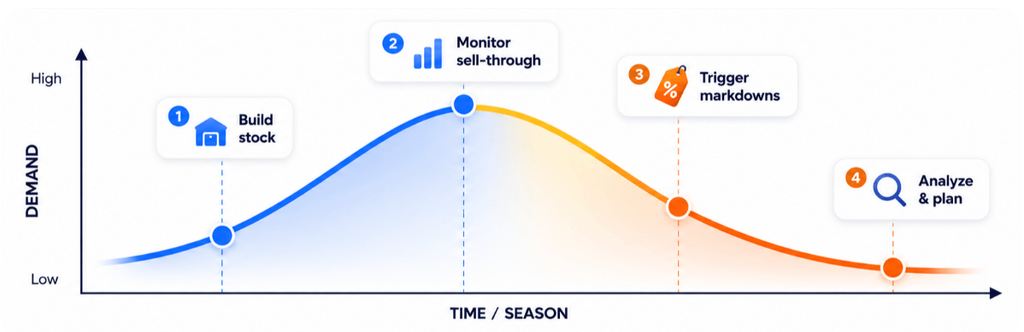
Seasonal demand curves are steeper and less forgiving compared to regular demand curves, so even slightly misjudged fluctuating demand hits harder. Common categories of seasonal stock include holiday decorations, lawn equipment, school supplies, winter apparel, HVAC filters, and agricultural products.
Why Seasonal Inventory Management Is Important
For seasonal businesses, getting inventory management right isn’t optional; it directly affects revenue, customer loyalty, and operational efficiency. A thoughtful seasonal inventory strategy helps you:
Prevent stockouts: Meet customer demand during high demand periods instead of losing sales to competitors.
Avoid overstock: Reduce excess stock and unsold seasonal inventory once the season ends, which often means steep markdowns.
Improve customer satisfaction: Keep products available across sales channels, including during off peak periods.
Reduce carrying costs: Minimize storage costs tied to managing inventory that only moves part of the year.
Improve cash flow: Free up capital tied up in an oversized seasonal inventory investment.
Support warehouse efficiency: Plan space and labor around predictable surges using on demand warehousing.
Improve purchasing accuracy: Order the right quantities based on historical sales data rather than guesswork.
Common Seasonal Inventory Challenges
Seasonal inventory management comes with a distinct set of obstacles:
- Demand forecasting: Accurately forecasting demand for how much of a seasonal item you’ll actually sell, i.e. learning to predict future demand, especially with limited historical data.
- Supplier lead times: Coordinating inventory purchases far enough in advance without holding stock too long beforehand.
- Storage constraints: Finding space for seasonal surges without permanently expanding your footprint.
- Labor shortages: Staffing up for short, intense periods of receiving, picking, and shipping.
- Supply chain disruptions: Absorbing delays or shortages caused by external factors that hit right when you can least afford them.
- Excess inventory: Managing remaining inventory left over once demand drops off.
- Stockouts: Running out of popular items mid-season and missing out on sales.
- Slow-moving inventory: Identifying seasonal SKUs that aren’t selling as expected before it’s too late.
These common seasonal inventory challenges show up year after year for businesses that manage seasonal inventory, and shorter trend cycles are compressing the windows businesses have to respond to unexpected demand spikes. With the right inventory decisions, you can manage these challenges proactively rather than reactively. In the next section we’ll dive into eight inventory management strategies that will set your business up for success.
Returns also spike after peak season, and without return material authorization (RMA) software, those items can sit uncounted while you reorder stock you already have.
8 Ways to Better Manage Seasonal Inventory
1. Track Historical Data and Plan Ahead
By looking at data from past sales, you can analyze historical data to determine the life cycle of a product, including the price and method of promotion that performed the best based on sales performance. You can also calculate the average length of the season and plan to have the right amount of stock to last throughout the peak period.
Before relying on this data, it helps to normalize your year-over-year (YoY) comparisons for a few outside factors:
- Weather: Unusual weather can inflate or deflate demand in a given year, so it’s worth comparing against average patterns rather than a one-off event.
- Past promotions: These can skew your baseline if not flagged, especially if the timing shifted to a different quarter than the current year.
- Economic conditions: Inflation and consumer confidence shift baseline demand independent of the season based on broader market trends.
Looking at your supplier history can also help you determine optimal reorder points and provide insight into the lead time of purchases. That is, what is the estimated time between ordering the goods and actually receiving them? Tracking performance data will more accurately forecast demand and help you plan for future demand shifts.
A garden retailer, for example, might spot an early-thaw skew in last year’s data and adjust its fertilizer reorder timing accordingly. You can use historical reporting tools that filter YoY data by SKU or location to isolate real trends from noise and shape future seasonal strategies.
2. Automate Purchase Orders
Automating purchase orders is a feature of many robust inventory systems. You should never run out of stock during the peak of your sales season. There is less time to move goods and turn them into sales, so you don’t want stock-outs holding you back.
With an automated purchase order system, you will reduce data inconsistencies between you and your suppliers. Automating this process to ensure reliable visibility among all parties is especially important when you have to account for seasonal surges in purchase order volume.
This matters even more if you operate across multiple locations. With automated replenishment, fed by real-time inventory visibility and barcode scanning, you can keep every site properly stocked without manual oversight at each one.
An HVAC distributor, for instance, might set reorder triggers to auto-trigger an AC parts restock before spring demand hits, rather than relying on manual monitoring that can fall behind once order volume spikes.
3. Use Predictive Analysis
Real-time technology allows you to make accurate predictions about the stock you have currently and the stock you will need in the future. Using data mining and predictive modeling, you can optimize your safety stock buffers and keep what you need on-hand to a minimum. If you have multiple locations, make sure you have a balance of inventory among your sites.
Rather than relying on a flat, year-round buffer, you can adjust inventory levels dynamically as demand shifts throughout the season. A holiday retailer, for example, might reallocate stock across locations based on early sales velocity, moving inventory to wherever it’s selling fastest.
Using predictive analytics tools that flag demand shifts in real time make this kind of rebalancing possible, giving you the visibility to act before a location runs low rather than after.
4. Offer Discounts and Market It
Markdowns are inevitable with seasonal inventory. However, you should carefully schedule them to maximize turnover and minimize profit loss.
Consider making the most of your markdowns and use it as an opportunity to generate market buzz. Clearance and sales could bring traffic and awareness to your brand that could carry over to your next sales period.
The key is timing your markdowns in tiers rather than jumping straight to deep clearance. A winter apparel retailer, for example, might start with a modest discount and only increase it if stock doesn’t move fast enough.
Tracking your sell-through rate is the best signal for knowing when it’s time to move to the next tier, giving you a data-driven way to time markdowns instead of guessing.
5. Calculate Your Inventory Expenses
You should be aware of the costs of goods sold and the costs of holding inventory. These calculations indicate if you have too much stock on hand and point to changes you should make. In preparation for peak season, you should always keep inventory expenses in mind.
What will your business do if the seasonal items don’t sell? Will you liquidate or will you hold it until next season for resale? Forecast your sales and margins, and anticipate all associated inventory costs to make your decision. You’ll introduce a higher volume of goods into your supply chain management process during seasonal periods. Your inventory management system should have features to help you handle that.
You can reduce carrying costs on seasonal goods by considering just-in-time inventory, accepting slightly tighter stock levels in exchange for lower storage expenses. A patio furniture retailer, for example, might choose to slightly understock rather than pay for off-season storage on bulky items.
6. Bundle Items Together and Sell as a Package Deal
Consumers are more encouraged to buy a product if they think they scored a value deal. Amazon uses a variation of this technique by dropping prices on expensive items like televisions, and then offering adapter and cable add-ons at full-price.
Taking that same idea, you can bundle Halloween costumes with related accessories. For the holidays, you can bundle less popular items with products that do well and offer it as a gift set.
Some consumers like to buy seasonal items ahead for the next year as well. A limited time package deal could provide more incentive to make the purchase now. Especially for seasonal inventory, your goal is to convert stock to sales as soon as possible.
You can use this same approach to move slow-moving stock: pair a struggling SKU with a bestseller, rather than resorting to a straight markdown, to convert stock to sales faster while protecting margin on the popular item.
7. Manage Your Personnel by Coordinating Schedules
Making sure you have the inventory to handle peak seasons is only half the battle. You also need to be confident that you will have the resources needed to manage the high volumes of inventory moving through your supply chain. For example, be sure to avoid having your employees take overlapping vacation time by coordinating schedules in advance.
You’ll need to check an influx of items into inventory, stock them onto shelves, and transact them to customers. There’s nothing worse than having enough inventory to sell but not enough personnel to handle the volume.
Cross-training your staff and staggering vacations ahead of peak season goes a long way. A back-to-school supplier, for example, might boost warehouse shifts two weeks before its peak, giving the team enough runway to flex to wherever the bottleneck shows up rather than being locked into fixed assignments.
8. Vendor Managed Inventory
Develop a visible supply chain and communicate with your suppliers. With vendor managed inventory, you can do all that and more. Not only can you maintain order processing accuracy, but you can also track inventory levels using minimum, maximum, and reorder points. For seasonal inventory, having your stock at the right time and location is the key to meeting seasonal demand seamlessly.
Additionally, consider drop-shipping seasonal products so you’re not left with an abundance of obsolete stock, particularly if you’re a small business and don’t produce your own goods. Not only would this allow for lower inventory and maintenance costs, but it could also increase your sales and profitability.
Set clear max/min thresholds with your vendors before peak season begins so you both have a shared understanding of when replenishment should happen. A construction supplier, for example, might let a vendor auto-ship materials once a job site’s stock runs low, rather than waiting for a manual reorder. VMI tools that give your suppliers real-time stock visibility make it much easier for you to prevent both stockouts and overstock.
Industries That Depend on Seasonal Inventory Management
- Retail: Holiday seasonal merchandise, from decorations to seasonal apparel, needs to be stocked, sold, and cleared within a tight window.
- Food and beverage: Seasonal ingredients require tight coordination between suppliers and shelf timing, a key part of supplier management.
- Agriculture: Planting and harvest cycles drive demand for seeds, fertilizer, and equipment, concentrated into narrow windows.
- Manufacturing: Seasonal demand spikes require planning raw materials and component inventory well in advance.
- Construction: Materials and equipment demand shifts with the seasons, ramping up in warmer months.
- HVAC: An almost perfectly seasonal curve across peak seasons, with furnace components in high demand ahead of winter and AC parts before summer.
Key Seasonal Inventory Metrics to Track
Strong seasonal forecasting depends on tracking the right KPIs (key performance indicators) from season to season and YoY. Here are a few KPIs to keep tabs on:
- Inventory turnover: How many times you sell and replace inventory over a period; extremely high turnover can mean stock levels are too lean.
- Sell-through rate: Percentage of inventory sold relative to what you received from a supplier.
- Stockout rate: How often you run out of stock, effectively measuring missed sales opportunities.
- Fill rate: Percentage of customer demand fulfilled immediately from available stock.
- Carrying cost: Total cost of holding inventory, including storage costs and shrinkage risk.
- Safety stock: Extra inventory held beyond expected demand to guard against forecasting errors.
- Average inventory / days inventory outstanding (DIO): Average number of days you hold average inventory before selling it.
- Forecast accuracy: How closely your projected demand matches actual demand.
Strong seasonal inventory forecasting only pays off if you have the real time visibility to know where your inventory actually is.
How Inventory Management Software Helps
Managing seasonal inventory effectively requires more than good instincts. It requires accurate, real-time demand data to be tracked in an inventory management system that can deliver quick and responsive changes to your inventory operations.
Clear Spider’s cloud-based inventory management platform offers a wide range of features that give businesses the visibility and control needed to stay ahead of seasonal demand shifts, including real-time inventory visibility, demand forecasting, barcode scanning, multi-location inventory, automated replenishment, reporting, mobile inventory access, and purchase order management. The payoff is simple: fewer stockouts, less excess stock, and more of your capital working for you instead of sitting on a shelf.
Book a demo to see how Clear Spider helps you stay ahead of seasonal demand.
Get Started!
Seasonal Inventory Management FAQs
Seasonal inventory is stock whose demand fluctuates predictably by time of year, requiring businesses to ramp up supply before peak periods and draw it down afterward.
By analyzing historical YoY sales data and adjusting for factors like weather, past promotions, and economic conditions that could skew the numbers.
It depends on demand variability and lead time reliability. A common starting formula is (Max Daily Usage × Max Lead Time) − (Average Daily Usage × Average Lead Time).
Common causes include underestimated demand spikes, skewed historical data, supplier lead time delays, and insufficient safety stock heading into peak season.
By providing real-time visibility, automating reorder points, and centralizing data so forecasts reflect actual demand patterns instead of guesswork.