
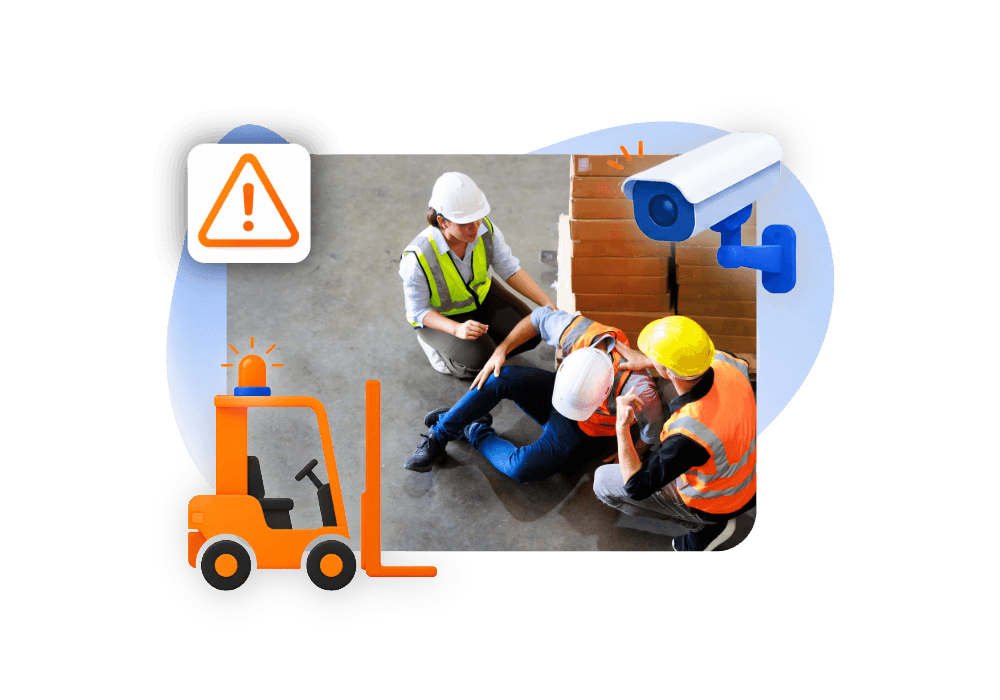
Warehouses are some of the most hazardous workplaces in any industry, with heavy equipment, constant vehicle traffic, and people all sharing the same space. Warehouse safety is the practice of managing those risks, and it has never mattered more for workplace safety than in today’s fast-paced work environments where: injuries drive up costs, disrupt operational efficiency, and expose businesses to costly OSHA violations.
Strong safety fundamentals will always come first, but modern technology is giving warehouses new tools to build on them. Artificial intelligence has become an increasingly important part of that toolkit, and its presence on the warehouse floor continues to grow. We have previously covered the effects AI has on supply chains; this time, we are turning to the warehouse floor.
In this article, we will cover:
- What warehouse safety is
- Why it matters
- Common warehouse hazards
- AI as a modern enhancement to warehouse safety
What does Workplace Safety look like in a Warehouse?
Warehouse safety combines regulatory standards with industry best practices to protect warehouse employees, covering both the warehouse environment and the everyday behaviors that keep operations safe and secure. On average, warehousing sees 4.7 injuries per 100 workers a year, nearly double the national average across other industries (U.S. Bureau of Labor Statistics, 2026).
The core objective of every warehouse safety program is preventing workplace injuries and fatalities, ranging from minor strains to serious injury. Other key objectives include:
- Reducing equipment-related accidents: forklifts and conveyors cause many serious incidents
- Ensuring compliance with OSHA regulations: meeting safety regulations protects workers and prevents fines
- Maintaining safe storage and material handling practices: proper stacking and lifting prevent falling objects and strains
- Creating structured emergency response systems: emergency preparedness plans for fires, spills, and injuries
Many of these focus areas map directly onto standards set by the Occupational Safety and Health Administration (OSHA), making those guidelines the starting point for any safety program.
OSHA Requirements for Warehouse Safety
The Occupational Safety and Health Administration (OSHA) is the United States federal agency that sets and enforces workplace safety standards. Non-compliance can be costly, with fines stacking up for each violation, and more importantly, workers’ safety is put at risk.
Key OSHA requirements include:
- Forklift certification: forklift operators require proper training and certification before getting behind the wheel
- Clearly marked pedestrian walkways: keeping foot traffic separated from vehicles
- Fire safety and exit accessibility: exits and evacuation routes must remain clear and marked
- Proper stacking and storage heights: loads must be stable, balanced, and within safe limits
- Machine guarding requirements: moving parts and electrical components on conveyors and machinery must be guarded
- Hazard communication: hazardous chemicals must be labeled so workers know what they are handling
- PPE requirements: personal protective equipment like gloves, vests, and helmets matched to specific tasks
Common Warehouse Safety Hazards
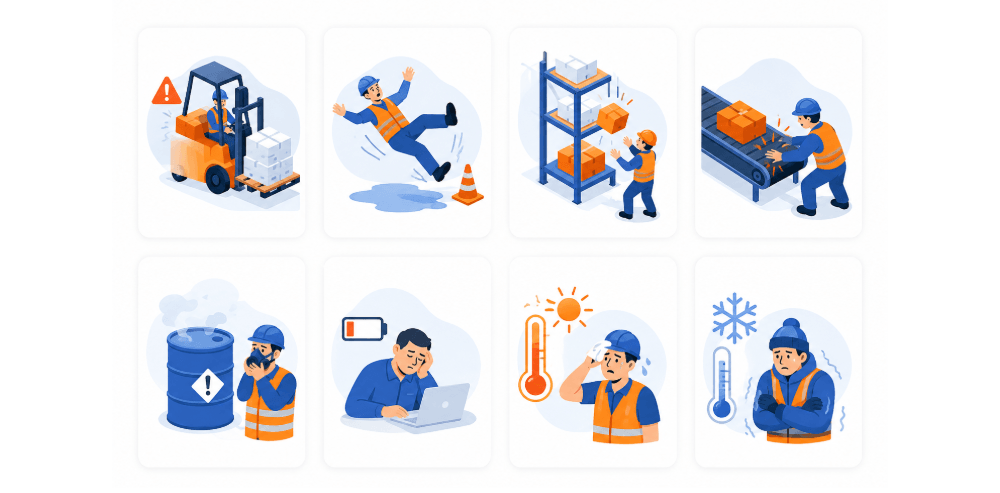
Forklift Accidents
Forklifts are among the most dangerous pieces of equipment in a warehouse, linked to roughly 70 to 85 workplace deaths a year (National Safety Council, 2026). Daily pre-start inspections that check brakes, steering, and warning signals catch problems before they cause harm.
Slips, Trips, and Falls
Wet floors, loose debris, and cluttered aisles are everyday hazards, and open loading docks raise the stakes even further, turning a routine misstep into a serious fall. Safety gates at these docks close that gap.
Falling Objects
Improperly stacked shelving puts anyone in the fall zone at risk, especially when heavier loads sit up top. Keeping heavier items on lower or middle shelves keeps the whole structure stable.
Conveyor Belt Injuries
Unguarded moving parts can catch clothing and hair.
Poor Manual Lifting Practices
Without proper ergonomics, repetitive lifting leads to musculoskeletal disorders, some of the most common injuries in warehousing.
Hazardous Material Exposure
Chemicals, cleaning supplies, and other dangerous goods require careful storage and handling.
Fatigue-related Errors
Tired workers make more mistakes and get hurt more often.
Extreme Heat
High temperatures and humidity, mixed with physical work, loss of fluids, and fatigue, can lead to heat exhaustion, heat-related illness, and even death.
Extreme Cold
Employees are susceptible to frostbite, trench foot, and hypothermia, and if snow melts and then freezes on the floor, it increases the risk of falls.
Warehouse Safety Checklist: Best Practices to Follow
These safety precautions form the backbone of a strong program, and a warehouse safety checklist built around them is one of the most effective ways to ensure safety day to day:
Regular safety training programs: Ongoing employee training keeps knowledge and safety protocols current and helps ensure proper training for every new hire.
Clear signage and hazard labeling: Visible warnings and floor markings keep risks top of mind.
Routine equipment inspections: Scheduled checks catch faulty equipment before it causes an accident. Regular safety sweeps also help identify and troubleshoot potential hazards while keeping walkways clear of slip and trip hazards.
Organized inventory management: Clutter and misplaced stock create trip hazards and unstable storage. Using the 5S method (Sort, Set in order, Shine, Standardize, Sustain) helps maintain an organized, clean workspace, and a warehouse management system keeps inventory organized and traffic predictable.
PPE enforcement systems: Requiring proper PPE is only the first step; consistent enforcement makes it effective.
Incident reporting systems: Accidents happen even with strong protocols in place; every incident and near-miss logged becomes data that helps prevent the next one. A Safety Committee can also help employees communicate safety hazards and concerns, reinforcing accountability.
How AI Is Improving Warehouse Safety
Tools like autonomous vehicles, smart monitoring, and predictive analytics give businesses the visibility and reaction speed that manual oversight simply can’t match — which matters most for companies managing inventory across multiple locations and protecting their workforce.
Autonomous Vehicles
Autonomous vehicles may bring self-driving cars to mind, but the technology has already gone well beyond our roads and into our warehouses. Companies like Amazon already use AI-equipped vehicles, built on that same underlying technology, to move inventory through their warehouses with safety in mind to prevent collisions. A network of sensors and cameras builds a 360-degree view of the surroundings, spotting people and obstacles in real time and reacting before contact.
This technology is improving warehouse safety through:
- Path optimization: every route is coordinated from one central system, preventing collisions and keeping vehicle traffic away from busy walkways
- Reduced human-machine interaction risk: fewer people working around heavy equipment means fewer accidents
- Reduced fatigue: by taking over the constant walking and pushing, autonomous vehicles cut the fatigue that leads to slower work, more errors, and higher turnover
AI-Powered Robots and Automated Workflows
AI in manufacturing is not new, but it has become increasingly important. By reducing manual labor and unifying the entire system, businesses can increase output without sacrificing consistency. Robots take on the repetitive, high-risk work humans shouldn’t have to, giving warehouses a steadier, more predictable floor. The safety payoff includes:
- Reducing human error: robots are not susceptible to fatigue, distraction, or end-of-shift rushing
- Making maintenance more predictable: AI monitors equipment health and schedules repairs before breakdowns, preventing accidents from faulty machinery
- Reducing strain injuries: robots absorb the high-repetition physical work that wears down human bodies
AI-Driven Warehouse Monitoring and Hazard Detection
Beyond assisting with manual labor, AI-driven warehouse management systems act as a third eye, helping warehouse managers oversee the entire facility and flag blind spots or coverage gaps as a potential safety hazard when poor visibility or connectivity could delay assistance and worsen an incident. Key capabilities include:
- Computer vision monitoring aisles: AI interprets camera feeds, handling hazard identification tirelessly and with precision
- Real-time hazard detection: spills, blocked exits, and obstructions get flagged instantly
- Heatmaps for unsafe zones: color-coded maps show where incidents and near-misses cluster
- Predictive incident alerts: warnings trigger when conditions match patterns that precede accidents
Predictive Safety Analytics
AI-driven warehouse management systems are also highly effective at identifying high-risk zones and injury patterns before they repeat. Here’s how it works:
1. Data collection: the system pulls automatically from incident reports, safety audits, near-miss logs, equipment sensors, environmental monitoring, and video feeds
2. Pattern recognition: machine learning identifies the factors that precede incidents, such as a machine overheating before a malfunction, and reveals spikes by zone, shift, or season
3. Near-miss detection: the system flags close calls that go unreported, surfacing risk zones before an injury happens
4. Prediction: the system forecasts where and when incidents are likely and can trigger automatic responses like supervisor alerts or access restrictions
This helps with:
- Tracking employee fatigue and workload risks: patterns in pace and errors flag overworked teams early
- Preventing incidents before they happen: this is where AI-driven warehouse management systems deliver their biggest safety gain, letting teams get ahead of problems instead of cleaning up after them
Benefits of AI in Warehouse Safety
Taken together, autonomous vehicles, AI-powered robots, and predictive analytics deliver:
Fewer workplace injuries: less exposure to the riskiest tasks
Faster hazard detection: threats flagged in real time
Improved compliance with OSHA standards: continuous monitoring catches violations early
Reduced equipment downtime: predictive maintenance stops breakdowns before they happen
Better visibility across operations: knowing where everything is, including how inventory is allocated, keeps floors organized
Safer human-machine collaboration: sensors let people and machines safely share space
Despite the impressive potential of AI in warehouse operations, it’s important to remember that AI always works best as a support for human operations, not a replacement. AI-driven warehouse operations are only as good as the data used to train them. For smaller warehouses, the cost to implement these systems can also be a significant barrier, which is why adoption often starts small and scales over time.
How to Build Safer Warehouses with Smarter Operations
None of the AI above works without the fundamentals that support it. Training, signage, inspections, and incident reporting are still what keep a warehouse safe day to day, and together they build the safety culture that all the advanced tech still depends on.
Inventory sits at the center of optimal warehouse operations. AI-driven warehouse management systems enhance both warehouse safety and inventory management by tracking stock in real time, flagging misplaced or mislabeled items as they happen, and predicting where clutter is likely to build up across zones or shifts before it turns into a hazard. They can also spot slow-moving or forgotten stock that quietly accumulates in corners and blocks sightlines, catching the kind of risk that’s easy to miss during a routine walkthrough.
Pair the predictive power of AI with a powerful cloud-based inventory management system like Clear Spider, and you maximize everyday control: organized stock, clear aisles, and the data to back up OSHA compliance.