
Supply chains are more fragmented than ever, and manual data exchange can no longer keep up. EDI inventory management is the automated, standardized exchange of inventory data between business systems and trading partners, covering stock levels, purchase orders, and shipping notices without manual input. Automating this exchange improves operational efficiency by reducing errors and accelerating transaction processing.
Modern supply chain management relies on multiple systems working together. ERPs, warehouse management systems, 3PLs, and retail platforms all need to communicate continuously. Combined with growing demand for real-time inventory visibility and the need to move beyond manual inventory management, automated data exchange has become essential.
In this guide, we will cover:
- What EDI is
- Why it matters
- How it works
- Key benefits of EDI
- Common use cases
- Best practices
What is EDI Inventory Management?
EDI (Electronic Data Interchange) is the computer-to-computer exchange of business documents in standardized electronic formats, replacing traditional paper-based methods such as mail, fax, and email and streamlining business processes along the way. EDI inventory management applies EDI technology to the inventory management process, enabling real-time syncing of stock levels, orders, and shipments across systems. Updates happen automatically, without manual input.
Most of this communication happens through four key EDI documents:
- EDI 846 (Inventory Inquiry/Advice): communicates inventory levels, item details, and inventory status across locations
- EDI 850 (Purchase Order): the digital version of a traditional purchase order
- EDI 855 (Purchase Order Acknowledgment): confirms an order was received and indicates whether it is accepted, rejected, or accepted with changes
- EDI 856 (Advance Ship Notice): provides critical details about shipment contents, packaging, and delivery
Since no two systems format data quite the same way, EDI translators sit in the middle, converting data to the EDI standard when sending and back to your system’s format when receiving.
EDI also has no universal standard, so trading partners must align on one upfront. The two most common are:
- ANSI X12: dominant in North America
- UN/EDIFACT: used globally
Keep in mind that EDI is a communication layer, not an inventory system. It moves data between systems but does not store, analyze, or display it. EDI is the pipe, and the inventory system is the dashboard.
Understanding what EDI is only tells part of the story. The next step is understanding why it has become a critical tool across modern supply chain operations.
Why EDI Matters for Inventory Management
Supply chain complexity continues to grow, with data flowing between ERPs, WMS platforms, 3PLs, and retailers. Currently, the majority of supply chain transactions are managed through EDI, making it standard practice across the entire supply chain rather than a niche tool.
Businesses need real-time inventory data across every sales channel, and they need it without human errors or operational delays. When implemented correctly, EDI helps prevent:
- Stockouts
- Overselling
- Inventory mismatches between systems
It is worth noting that each 3PL has its own proprietary EDI specifications, meaning an order placed with 3PL X requires different formatting than the same order placed with 3PL Y. This is precisely why EDI automation matters.
Customer demands are also rising across B2B and omnichannel retail. With consumers now expecting same-day or two-day delivery as a standard option, meeting customer demands with slow, error-prone manual processes is no longer sustainable.
How EDI Works
EDI operates as a continuous sync loop rather than a one-time transaction. A typical order flow looks like this:
- Buyer sends an EDI 850 (Purchase Order)
- Supplier checks stock via EDI 846 (Inventory Inquiry/Advice)
- Supplier confirms with an EDI 855 (Purchase Order Acknowledgment)
- Goods ship, and the supplier sends an EDI 856 (Advance Ship Notice)
- Inventory updates automatically across both systems
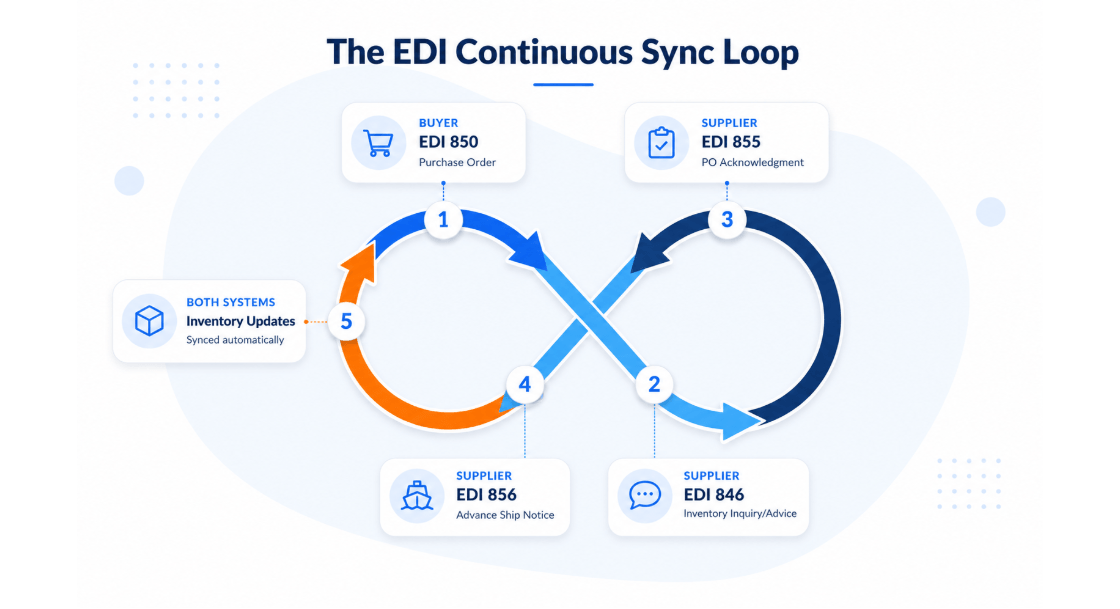
Every transaction triggers a response, keeping trading partners’ systems aligned without manual intervention.
Data moves between trading partners through two main methods:
- VAN (Value-Added Network): a secure private network that acts as both messenger and translator. It manages a virtual mailbox for incoming documents and simplifies setup by handling multiple partner connections through a single provider.
- AS2: direct, encrypted transmission over the internet using digital signatures and certificates. It avoids VAN fees and is preferred in retail and logistics.
In both cases, EDI translators sit between internal systems and the transmission method, handling format conversion in each direction.
Key Benefits of EDI Inventory Management
Inventory Accuracy
Automated processing eliminates the manual data entry errors that come with manual inventory checks, delivering accurate inventory tracking and improved data consistency across every connected platform.
Real-Time Visibility
Real-time inventory management gives businesses up-to-date stock information across warehouses and partners, supporting informed decisions about allocation and purchasing. EDI integration also delivers improved accuracy in demand forecasting, since real-time data reveals sales trends as they happen. Pairing that data with intelligent inventory solutions extends the value further.
Faster Order Fulfillment
Automated communication between systems cuts down on processing delays, helping businesses shorten their order-to-cash cycles. Faster, more reliable fulfillment translates directly into improved customer satisfaction.
Lower Operational Costs
Less manual reconciliation means lower labor costs, fewer shipping and inventory errors, and fewer chargebacks from trading partners, adding up to significant cost savings.
Better Partner Coordination
Standardized communication across suppliers, retailers, and 3PLs builds trust, keeps every partner working from the same data, and improves supply chain efficiency across the board.
Common Use Cases of EDI Inventory Management
Retail and Omnichannel Commerce
- Syncing inventory across online and physical retail locations in real time
- Preventing overselling by giving staff and customers accurate product availability
- Sharing real-time sales data across channels for smarter demand planning
- Enabling vendor-managed inventory (VMI), where suppliers proactively send EDI 846 documents to maintain optimal stock levels
Manufacturing and Production
- Automatic purchase order creation based on production schedules
- Continuous monitoring of inventory levels and threshold-based ordering driven by replenishment parameters
- Production planning based on confirmed material deliveries
- Cross-docking operations that move incoming materials directly to production
3PL and Logistics Providers
- Managing multi-client inventory in shared warehouses
- Automatically transmitting stock levels, shipments, and receipts
- Providing real-time reporting to clients
Wholesale Distribution
- Tracking large SKU volumes across multiple locations
- Optimizing stock levels and ensuring timely replenishment across locations
- Strengthening partner relationships through accurate, shared stock data
EDI Inventory Management Best Practices
Standardize EDI Formats Across Trading Partners
Agree on a standard and version upfront. This reduces mapping inconsistencies and prevents issues before your EDI processes reach production.
Integrate EDI With a Centralized Inventory Platform
Establish connections between your EDI solution and existing systems such as ERP, WMS, and accounting to enable real-time data exchange.
Prioritize Real-Time Data Synchronization
Understand the tradeoffs between batch and real-time processing. Near real-time synchronization is preferred wherever feasible.
Regularly Audit Inventory Accuracy
Timestamped EDI-to-ERP logs support compliance requirements and help reduce chargeback disputes with trading partners.
Automate Exception Handling
Set up automatic alerts for failed or mismatched EDI transactions, and create exception-handling workflows so teams can respond in near real time rather than discovering problems days later.
Align EDI With Broader Supply Chain Strategy
Map internal data formats to EDI standards before go-live, and test thoroughly. Connectivity, data elements, and transaction formatting all require validation. Treat EDI as part of broader supply chain optimization, not a standalone project.
Following these practices sets a strong foundation for effective inventory management, but it is equally important to understand the challenges that come with implementation.
EDI Inventory Management Challenges
Implementing EDI delivers significant value, but it requires meaningful setup effort and the right infrastructure. These challenges are manageable when planned for early.
System Integration Complexity
ERP, WMS, and supplier systems must all connect correctly. Disconnected systems force teams back into manual tracking and duplicate data entry, increasing error risk and blocking real-time visibility.
Legacy System Limitations
Legacy EDI relies on batch processing, which introduces significant latency. For example, a purchase order arriving at 1:05 PM may not reach the ERP until the 1:30 PM batch run, and may not be processed until the 2:00 PM cycle. That creates nearly an hour of lag for a single transaction.
Data Mapping and Standardization Issues
Different partners use different EDI formats, so internal data must be mapped on a partner-by-partner basis before transmission.
High Setup and Maintenance Effort
EDI requires technical configuration, ongoing support, and partner-by-partner onboarding. Most businesses should expect 3 to 6 months from initial assessment to full operational capability. Many choose to work with an EDI solution provider to shorten that timeline, and it is worth assessing whether your business is ready for inventory management software early in the process.
How Clear Spider Enhances EDI Inventory Management
EDI moves data, but it does not solve visibility. A dedicated inventory management platform is what turns that transaction data into actionable insight. Without one, businesses are still left with:
- No centralized view across locations
- No unified data layer across systems
- No real-time visibility, only raw documents moving between endpoints
Clear Spider fills this visibility gap by sitting on top of EDI-connected systems and making the data usable:
- Centralized visibility: One unified view of inventory across every warehouse and location
- Real-time synchronization: Stock data stays aligned across all your EDI-connected systems as transactions happen
- Fewer discrepancies: Records match what’s actually on the shelf, not what a batch update said hours ago
- Smoother coordination: Suppliers, warehouses, and customers all work from the same accurate data
- Operational control: Tighter oversight across multi-location inventory environments
- Built to scale: Grows with your supply chain and trading partner network, no matter how complex
EDI keeps data moving across your supply chain processes, but pairing it with a centralized inventory platform is what transforms that data into accurate, real-time visibility. That combination is the foundation of efficient supply chain management, and Clear Spider bridges the gap by connecting EDI workflows to a single source of truth for inventory.